
The University of Lagos (UNILAG) has called on its younger alumni and other stakeholders to take an active role in advancing the institution through strategic partnerships, financial contributions and sustained engagement. The call followed the launch of its ₦5 billion Vision 200 Endowment Development Fund campaign.

The Vice-Chancellor, Professor Folasade Ogunsola, OON, FAS, made the call at the 2026 Younger Alumni Stakeholder Engagement held on Friday, November 13, 2026, at the MAD House/Lagoon Front, University of Lagos. The event brought together members of the University Management, the Advancement Board, alumni, industry leaders, and partners of the University to strengthen relationships and explore opportunities for institutional development.

Alumni Support Crucial to Building a Future-Ready University
Speaking at the engagement, Professor Ogunsola emphasised that the responsibility of building a world-class university extends beyond its management to everyone who has benefited from the institution.
She described the University as a collective project and urged alumni to contribute their professional experience, networks, expertise and resources towards its growth.
Professor Ogunsola acknowledged the challenges facing the Nigerian university system but noted that these had also strengthened the creativity, resilience and problem-solving abilities of its students and graduates. She stressed the need to strengthen local institutions to provide quality education while preserving the cultural identity and values of future generations.
The Vice-Chancellor further underscored the importance of collaboration, noting that the collective capacity of alumni and other stakeholders could achieve far more than individual efforts.
Vision 200 Targets ₦5 Billion Endowment Fund
A major highlight of the engagement was the launch of Vision 200, a campaign to raise ₦5 billion towards establishing an Endowment Development Fund for the University.

Explaining the rationale behind the initiative, Professor Ogunsola noted that reliance on a single source of income leaves universities vulnerable to financial challenges. She therefore encouraged alumni to support the University’s efforts to diversify its revenue base through donations, recurring contributions, business partnerships and other forms of investment.
She explained that the endowment’s principal would be protected and invested, with the returns providing a sustainable source of funding for the University’s development.
According to her, the fund would support key areas, including infrastructure, research and innovation, teaching, and staff development. She added that contributions need not be substantial to make an impact, as consistent donations of different sizes could collectively generate significant support.
The Vice-Chancellor also said the campaign had received commitments from founding donors and thanked them for their confidence in the University’s vision.
FIRM Agenda: Four Pillars for Institutional Transformation
Professor Ogunsola also highlighted the University’s FIRM Agenda, the strategic framework her administration champions to drive institutional transformation and position UNILAG for the future. FIRM represents four key priorities: Financial Re-engineering, Infrastructure Development, Reputation Enhancement and Manpower Development.

On Financial Re-engineering, she highlighted ongoing efforts to diversify the University’s revenue base through existing enterprises, alumni contributions and partnerships with private-sector organisations.
Under Infrastructure Development, she discussed the University’s digital transformation, including campus-wide connectivity and the digitisation of administrative processes. Enterprise resource planning systems, she explained, had been deployed across various units, including Human Resources, the Medical Centre and faculties, to improve operational efficiency. She also highlighted efforts to digitise historical academic records and transcripts to reduce administrative delays and improve service delivery to alumni.
On Reputation Enhancement, the Vice-Chancellor stressed the importance of strengthening the University’s standing through quality teaching, impactful research, innovation and strategic partnerships.





For Manpower Development, she emphasised the need to invest in the capacity and welfare of both academic and non-academic staff, noting that the quality of a university’s graduates is closely linked to the quality of its workforce.
She also highlighted the University’s exploration of alternative energy sources to reduce its substantial electricity expenditure and provide a more reliable environment for teaching, learning and research.

Chairman Calls for Collective Ownership of University’s Vision
Earlier, the Chairman of the University of Lagos Advancement Board, Chief Bayo Ojo, CON, SAN, described the engagement as an opportunity to celebrate the University’s achievements, reconnect alumni and stakeholders, and secure collective commitment to its future.
Reflecting on his student days, Chief Ojo shared how helping a fellow student who was struggling to adjust to academic life by sharing his lecture notes developed into a lifelong friendship. The student later became his roommate and best man. The experience, he noted, illustrated the enduring relationships that can emerge from the University community.
He maintained that the University’s ambition to become Africa’s most innovative and entrepreneurial university, while improving its global standing, would require sustained support and collective commitment.



Describing younger alumni as a vital source of energy, networks and fresh ideas, he urged them to move beyond celebrating their shared history and become active contributors to the University’s future.
University Showcases Research, Innovation and Entrepreneurial Solutions
As part of the engagement, members of the University Management and other stakeholders embarked on a tour of selected University facilities and innovation platforms, where they were introduced to research outputs, technological solutions and entrepreneurial initiatives emerging from the University’s innovation ecosystem.
The innovations showcased included an amniotic fluid detector designed to help identify preterm rupture of membranes, a pregnancy complication that can pose serious risks to mothers and babies. The innovation seeks to support early detection and improve maternal and child health outcomes.
Also featured was a solar-powered electrolyser, which uses solar energy to split water into hydrogen and oxygen. The hydrogen can serve as an alternative energy source, while the oxygen has potential medical applications, particularly in addressing oxygen supply needs.
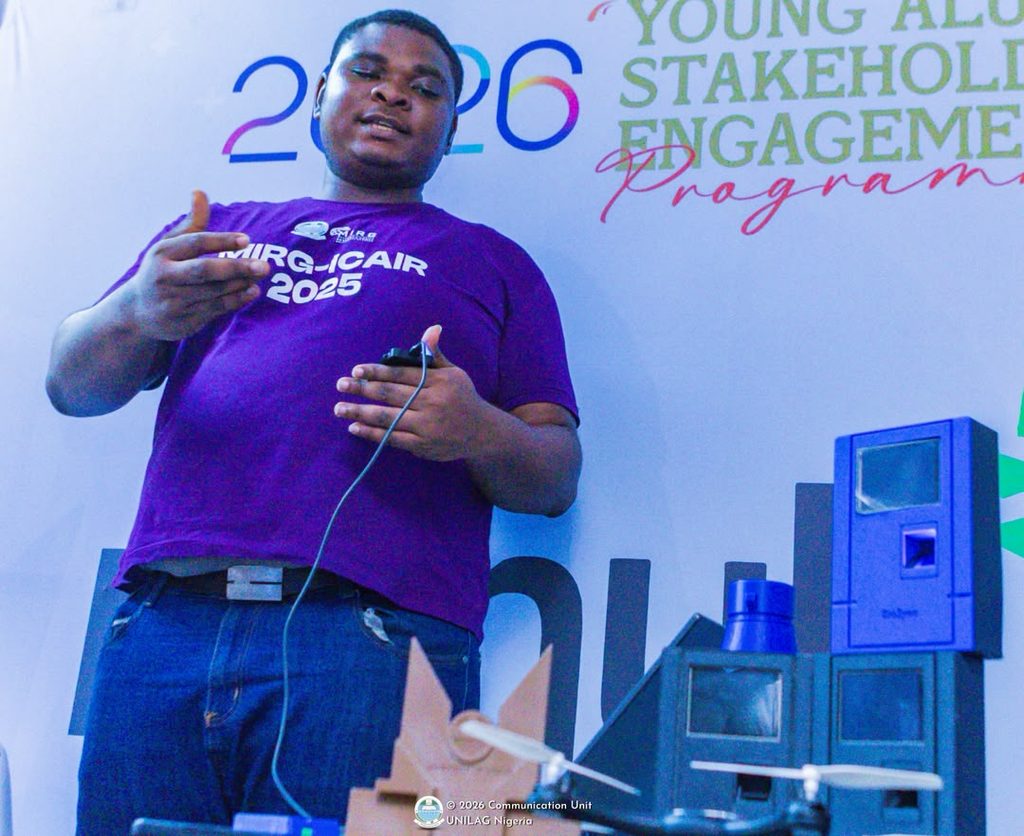



Another innovation on display was an environmentally friendly protective coating developed as an alternative to conventional solvent-based coatings that may contain volatile organic compounds and other hazardous substances. The product has undergone testing, received certification from the Standards Organisation of Nigeria and is ready for commercialisation.
The tour also provided an overview of the University’s innovation and technology management, production skills development and design facilities, highlighting its efforts to translate research into practical solutions and commercially viable products.
The showcase underscored the University’s capacity to generate innovations with practical applications across healthcare, energy and environmental sustainability. It also provided an opportunity for alumni and other stakeholders to appreciate the potential of the University’s research outputs and explore avenues for supporting their development, investment and commercialisation.
Alumni Demonstrate Commitment Through Financial Pledges
The engagement provided an opportunity for alumni and other stakeholders to demonstrate their support through financial pledges and offers of assistance towards various University development priorities.
The pledge segment was facilitated by the Director, Office of Advancement, Dr. (Mrs.) Taiwo Ipaye, FNIM, as alumni and other stakeholders made commitments in support of the University’s advancement efforts.






Members and representatives of different faculties also expressed their willingness to contribute to their respective academic communities, reinforcing the importance of alumni participation at both faculty and institutional levels.
Earlier, the Vice-Chancellor had urged younger alumni to support the University’s advancement efforts through three key actions: give generously, bring others and stay close.
She encouraged them to make financial commitments, mobilise fellow graduates and maintain open communication with the University, including offering constructive feedback on areas requiring improvement.
The 2026 Younger Alumni Stakeholder Engagement reinforced the University of Lagos’ commitment to strengthening alumni relations and harnessing the collective resources, expertise and goodwill of its stakeholders towards building a financially sustainable, innovative and globally competitive institution.
Report: Lynda Onah
Photograph: Ayo Oloyede